Should You Buy Land, an Apartment, or a Villa for Long-Term Value? A Complete Real Estate Investment Guide
Buying property is a big decision. For some people, it means finally owning a home. For others, it is a way to build wealth, generate rental income, or create an asset for the future.
But when you start exploring the real estate market, one question often comes up:
Should you invest in land, an apartment, or a villa for long-term value?
There is no one-size-fits-all answer. Each property type has its own advantages, costs, responsibilities, and investment potential. The right choice depends on your budget, location, financial goals, expected holding period, and whether you want the property for personal use or investment.
For example, someone planning to hold a property for 10–15 years may look at it very differently from someone who wants a ready-to-use home today. Similarly, a property in a developing corridor may have a completely different potential from one located in an already established neighbourhood.
So, instead of asking “Which property is best?”, it is more useful to ask:
“Which property makes the most sense for my goals?”
Let’s understand the differences between land, apartments, and villas and what you should consider before making a decision.
Land, Apartment or Villa: What Are You Actually Buying?
Before comparing their long-term value, it helps to understand what each option offers.
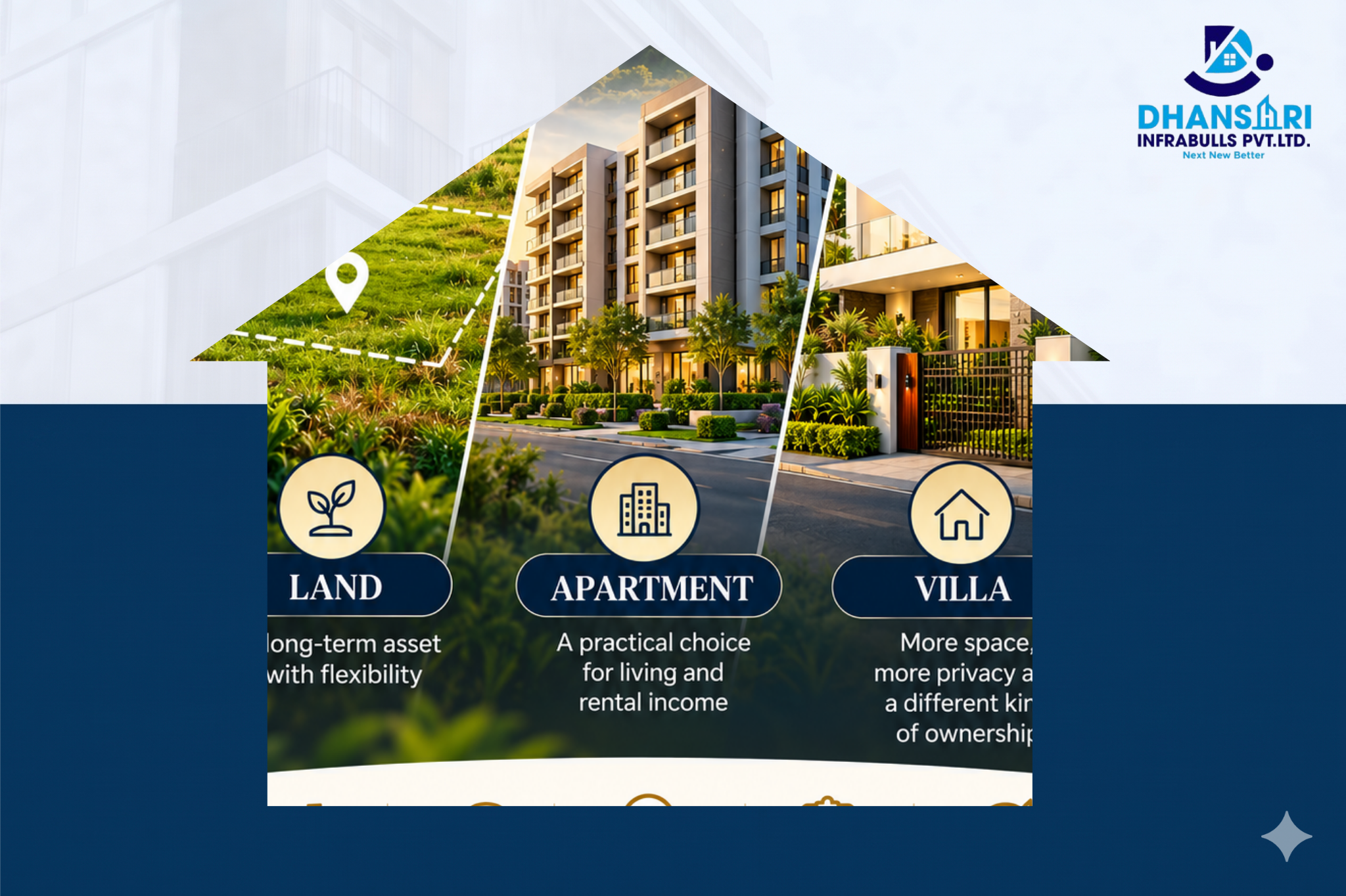
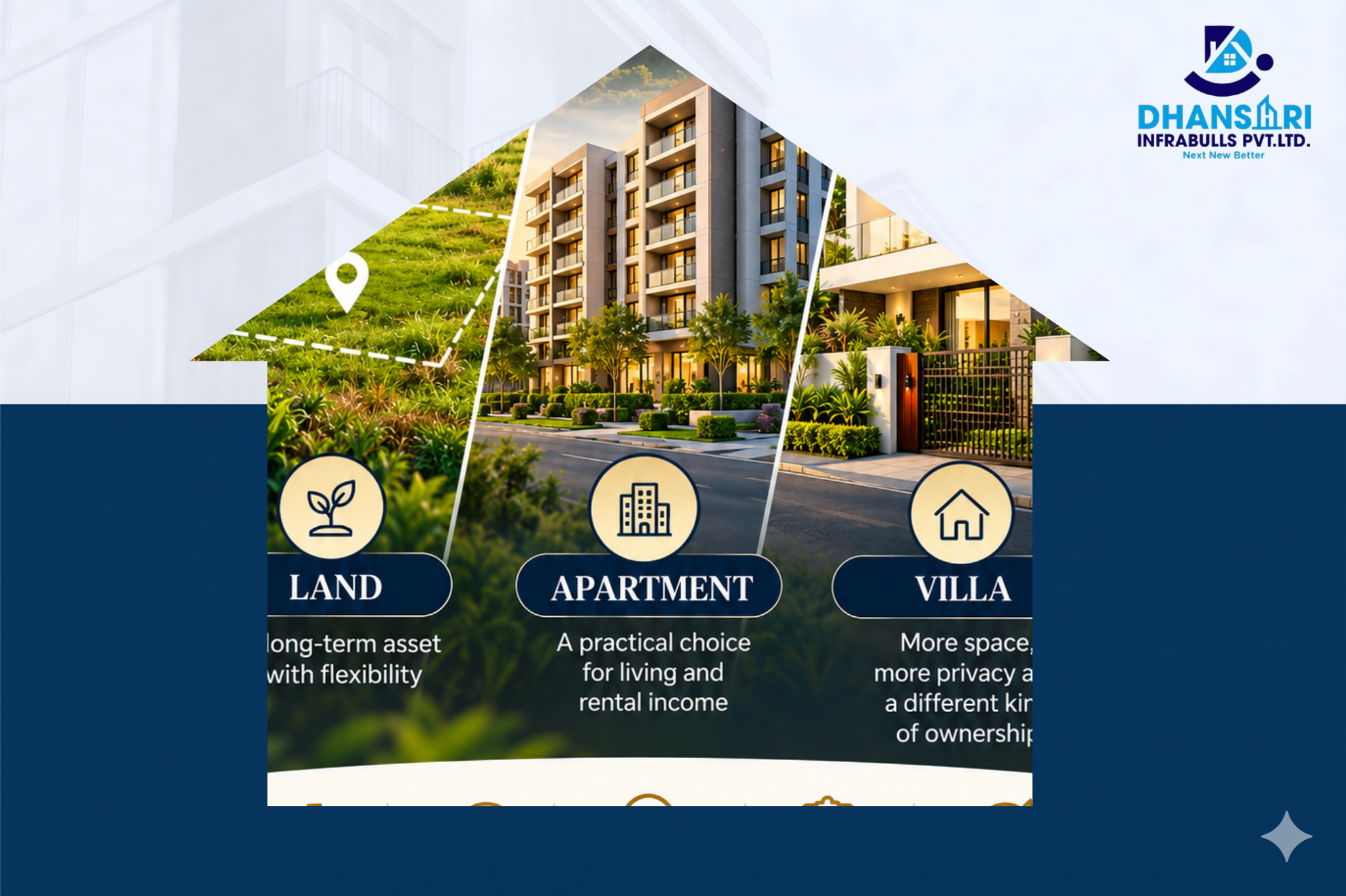
1. Land: A Long-Term Asset With Flexibility
Land is often considered a long-term investment because you are purchasing the underlying piece of property rather than a constructed building.
As an area develops, factors such as better roads, new businesses, employment opportunities, residential development, and improved infrastructure can influence demand for nearby land.
One major advantage is that vacant land does not age in the same way a constructed property does. However, this does not mean that every plot will automatically increase in value.
Location matters enormously.
A plot near a developing residential area, employment hub, industrial corridor, or major infrastructure project may attract future demand—but only if the expected development actually happens.
Another advantage is flexibility. Depending on zoning, approvals, and local regulations, the owner may eventually be able to construct a home or another permitted property on the plot.
The downside? Vacant land usually does not provide regular rental income. You may also have expenses related to taxes, security, boundary maintenance, and documentation.
Land may be worth considering if you:
- Are comfortable with a long-term investment.
- Do not need immediate rental income.
- Can hold the property without depending on a quick resale.
- Have researched the area's actual development potential.
- Are willing to complete proper legal verification.
- Want the option to construct in the future, subject to applicable permissions.
The important point: With land, the location, title, accessibility, permitted land use, and purchase price can make a huge difference.
2. Apartment: A Practical Choice for Living and Rental Income
Apartments remain a popular choice because they can combine homeownership with convenience.
A good apartment project may offer access to schools, hospitals, workplaces, markets, public transport, parking, security, gardens, gyms, and other shared amenities.
For investors, one of the biggest attractions can be rental income.
If an apartment is located in an area with consistent demand from working professionals, families, students, or people relocating for work, it may have better chances of attracting tenants.
Rental income can help cover some ownership expenses such as maintenance, taxes, loan payments, and repairs.
But apartments also come with their own considerations.
The building will age over time, and its condition, construction quality, maintenance standards, and management of common areas can influence both rental demand and resale appeal.
You also need to consider recurring expenses such as maintenance charges, repairs, insurance where applicable, property taxes, and other society or association-related costs.
An apartment may suit you if you:
- Want a ready home for yourself or your family.
- Want the possibility of rental income.
- Prefer being close to workplaces and daily conveniences.
- Want access to shared residential amenities.
- Have a moderate budget compared with an independent house.
- Prefer a property that can potentially be rented while you hold it.
When evaluating an apartment, don't look only at the purchase price. Also consider the project's location, rental demand, monthly expenses, construction quality, maintenance, and future resale market.
3. Villa: More Space, More Privacy and a Different Kind of Ownership
For buyers who want more space and privacy, a villa can be an attractive option.
A villa generally combines a house with private outdoor space. Depending on the project's legal structure, the buyer may also own the underlying plot, while certain areas of a gated community may remain subject to common ownership or association rules.
For families, the appeal is often straightforward: more privacy, larger living spaces, an independent entrance, outdoor space, and greater control over the home.
From an investment perspective, a villa can have two important components of value—the land and the house itself.
However, villas generally require a higher initial investment than many apartments. Maintenance can also be higher because owners may be responsible for areas such as the garden, exterior, plumbing, electrical systems, roof, and other private facilities.
Rental demand is another factor to consider. Villas may attract families or tenants looking for premium accommodation, but the number of potential tenants can be smaller than for apartments in more affordable price ranges.
A villa may make sense if you:
- Want a long-term family home.
- Prefer privacy and independent living.
- Have a higher purchase and maintenance budget.
- Want more outdoor space.
- Plan to hold the property for several years.
- Have identified a location where there is genuine demand for premium housing.
A villa can provide both lifestyle benefits and long-term asset value, but the purchase should still fit comfortably within your finances.
Which Property Can Offer Better Long-Term Appreciation?
This is where things get interesting.
It is easy to assume that land always appreciates faster than an apartment or that a villa will always command a higher resale value.
Real estate doesn't work that simply.
Long-term appreciation can be influenced by:
- Location
- Demand and supply
- Infrastructure
- Employment opportunities
- Population growth
- Property quality
- Land availability
- Legal clarity
- Purchase price
- Overall economic conditions
A well-located apartment can perform differently from a poorly located plot. Similarly, a villa in an area with limited demand may not perform the way a buyer expects.
So rather than focusing only on the type of property, look at the complete picture.
|
Factor
|
Land
|
Apartment
|
Villa
|
|
Main value drivers
|
Location, land demand and area development
|
Location, housing demand, project quality and building condition
|
Land value, location, house quality and demand
|
|
Rental income
|
Usually unavailable while vacant
|
Possible
|
Possible, depending on demand
|
|
Maintenance
|
Generally lower, but site security/upkeep may be needed
|
Society/common maintenance + interior repairs
|
Usually higher due to independent structure and outdoor space
|
|
Initial investment
|
Varies significantly by location and size
|
Available across different budget ranges
|
Generally higher for premium locations
|
|
Resale
|
Depends strongly on location and buyer demand
|
Depends on affordability, location and project demand
|
Depends on price range and available buyer pool
|
|
Flexibility
|
Construction possibilities depend on approvals
|
Limited by building and society rules
|
Greater flexibility, subject to local and community rules
|
|
Key concerns
|
Title, access, approvals and land use
|
Building quality, maintenance and project supply
|
Capital requirement, maintenance and resale demand
|
This comparison is a general guide. Actual performance can vary significantly from one property to another.
The property with the highest price is not automatically the property with the highest long-term value.
What matters is whether the property's price, location, costs and future demand fit your financial plan.
Why Location Can Matter More Than Property Type
In real estate, you will often hear the phrase:
“Location matters.”
And there is a reason this remains one of the most important considerations.
People want to live close to places that make everyday life easier—offices, schools, hospitals, markets, public transport, entertainment, and other essential services.
Imagine two different properties.
One is a plot in an area where roads and utilities are still developing and there is little evidence of actual housing demand.
The other is an apartment in an established neighbourhood surrounded by workplaces, schools, hospitals and regular rental demand.
The first property is land, but that alone does not make it a better investment.
Now imagine another plot—this time legally approved, well connected, supported by existing infrastructure and located in a growing residential corridor with genuine buyer demand.
That could present a very different investment opportunity.
Before buying, look at:
- Road connectivity and actual travel time.
- Public transport availability.
- Nearby schools and hospitals.
- Markets and daily conveniences.
- Existing residential development.
- Employment and commercial activity.
- Water, electricity and drainage.
- Actual property transactions rather than only advertised prices.
- Future development plans.
- Competing properties available for sale or rent.
Be careful with properties marketed mainly around a “future highway,” “upcoming airport,” “proposed industrial corridor,” or similar announcement.
Before treating future infrastructure as a reason to invest, verify its status through reliable official sources. A proposed project, an approved project and an under-construction project are not the same thing.
What About Rental Income?
If you want your property to generate income while you own it, rental potential becomes an important part of the decision.
Vacant land generally does not provide regular residential rent.
Apartments, on the other hand, often have a straightforward rental model. You purchase the unit, prepare it for occupancy and rent it to a suitable tenant.
But don't calculate your returns using rent alone.
Consider:
- Expected monthly rent
- Vacancy periods
- Maintenance
- Property taxes
- Repairs
- Insurance, where applicable
- Property management costs
- Loan interest and financing costs
Villas can also generate rental income, especially in locations where larger homes are in demand. However, a higher purchase price does not automatically mean proportionately higher rent.
A simple rental-yield example
Suppose you purchase an apartment for ₹60 lakh and receive ₹20,000 per month in rent.
Annual rent:
₹20,000 × 12 = ₹2,40,000
Gross rental yield:
₹2,40,000 ÷ ₹60,00,000 × 100 = 4%
This is only a hypothetical example and should not be treated as a current market rental rate.
Your actual return can be lower after accounting for vacancies, maintenance, taxes, repairs, insurance and other expenses.
The takeaway is simple:
Don't just ask, “How much rent will I get?” Ask, “What return am I getting on the total amount invested?”
Your Investment Time Horizon Matters
Another question buyers often overlook is:
How long can you comfortably hold the property?
Your answer can change the way you evaluate land, apartments and villas.
If you're thinking about 1–3 years
Short-term property investing can involve considerable uncertainty.
Buying costs, taxes, market movements, selling expenses and buyer demand can all affect the outcome.
If you are purchasing with a short holding period in mind, make sure you can financially manage the property if you need to hold it longer than expected.
If you're thinking about 3–7 years
For a medium-term investment, location, purchase price, rental potential and resale demand become especially important.
An apartment may provide rental income during the holding period. A villa may work for someone who plans to live in it for several years. Land may suit someone who is comfortable waiting for development and demand to grow.
There is no guaranteed outcome for any of these options.
If you're thinking about 7–15 years or more
A longer holding period can give an investor more time to benefit from changes in infrastructure, employment, population and housing demand.
Land may benefit from urban expansion. Apartments and villas may combine potential appreciation with personal use or rental income.
But remember: time alone does not turn a poor purchase into a good one.
An overpriced property, weak location, unclear documentation or unaffordable loan can create problems even over a long period.
Don't Skip Legal Verification
A property can look perfect on paper.
Great location. Attractive price. Good connectivity. Promising future development.
But if the ownership documents or approvals have problems, the investment can become complicated.
Legal due diligence is especially important when purchasing land, but apartments and villas also require proper document verification.
Before buying land, check:
- Ownership and title documents
- Chain of title
- Encumbrances and registered mortgages
- Relevant litigation
- Survey number and plot boundaries
- Physical and legal access
- Applicable land-use classification
- Conversion permissions where applicable
- Layout approvals
- Development authority restrictions
- Acquisition notifications
- Utility availability
- Pending dues and restrictions
Never rely only on a broker's verbal assurance, brochure, boundary wall or neighbouring construction.
Before buying an apartment, review:
- Developer's title or rights over the project land
- Applicable project registrations
- Required approvals
- Approved building plans
- Occupancy/completion documentation where applicable
- Agreement for sale
- Sale deed
- Payment schedule
- Maintenance charges
- Owners' association information, where available
- Parking rights
- Common-area arrangements
- Outstanding dues or disputes
Where applicable, buyers should also verify project information through the relevant state RERA portal.
Before buying a villa, check:
Along with the house and construction documents, verify the ownership rights over the plot, common-area arrangements, gated-community rules, maintenance responsibilities and permissions for future construction or modifications.
Property laws and documentation requirements can vary depending on the state, land category and local development authority.
For a major property purchase, taking advice from a qualified local property lawyer can help identify potential legal issues before you commit your money.
So, Land, Apartment or Villa?
The answer depends on what you want your property to do for you.
If your priority is holding an asset for the long term and you do not need immediate rental income, land may be worth exploring.
If you want a home with the possibility of rental income and access to established residential infrastructure, an apartment may fit your requirements.
If you want privacy, more space and a long-term family home—and your budget allows for the purchase and maintenance—a villa may be worth considering.
But don't make the decision based only on the property category.
Look at the location, legal status, purchase price, infrastructure, demand, maintenance costs, rental potential and your own financial capacity.
Final Thought
Real estate is rarely about finding a property that is simply “the best.”
It is about finding a property that makes sense for you.
Take your time. Visit the location. Compare similar properties. Check the documents. Understand the total cost. Research actual demand instead of relying only on marketing promises.
And most importantly, don't let the excitement of buying property replace proper due diligence.
A well-researched property decision today can help you build a more secure asset for tomorrow.